Singapore boasts one of the most sophisticated and highly regulated transport infrastructures globally. To maintain the structural integrity of its roads, expressways, flyovers, and underground tunnels, the Land Transport Authority (LTA) enforces strict rules governing oversized and overweight vehicles.
When your logistics operations cross beyond standard vehicular legal limits, a standard transport plan will no longer suffice. You will require an Oversized Vehicle Movement (OVM) Permit, commonly referred to as a Heavy Haulage Permit.
Navigating the compliance structures, calculation matrixes, and auxiliary escort mandates set by the LTA can be highly complex. This detailed guide breaks down everything you need to know about when a heavy haulage permit is required, how the application process works, and how partnering with an established logistics specialist ensures seamless approval.
What is an Oversized Vehicle Movement (OVM) Permit?
An Oversized Vehicle Movement (OVM) Permit is a regulatory clearance issued by the LTA in Singapore. It grants a specific vehicle or trailer configuration legal authorization to traverse designated public roads while carrying an indivisible load that exceeds standard statutory dimensions or weight limits.
An indivisible load is defined as a cargo item that cannot be broken down into smaller pieces without undue expense or risk of damage (such as heavy construction equipment, industrial boilers, structural steel beams, or prefabricated prefinished volumetric construction modules).
When Do You Need a Heavy Haulage Permit in Singapore?
Singapore’s Road Traffic (Motor Vehicles, Construction and Use) Rules define the baseline legal limits for any vehicle traveling on public roads. If your vehicle, inclusive of its loaded cargo, crosses any of the following statutory thresholds, a heavy haulage permit is legally mandatory before deployment.
1. Dimensional Thresholds
- Total Width: Exceeding 2.6 meters.
- Total Length: Exceeding 12.0 meters for rigid vehicles, or 18.0 meters for articulated vehicles (such as prime movers with low-bed trailers).
- Total Height: Exceeding 4.5 meters. Note: Singapore infrastructure features tight overhead bridge Clearances. Any vehicle exceeding 4.5 meters must follow heavily audited routes.
2. Weight Thresholds
- Gross Vehicle Weight (GVW): Exceeding 24,000 kg (24 tonnes) for vehicles with 3 axles, or 32,000 kg (32 tonnes) for vehicles with 4 or more axles.
- Axle Load Limits: Exceeding 10,000 kg (10 tonnes) on a single driving/axle unit, or 16,000 kg on tandem axles.
If your project parameters hit or exceed these figures, you must engage a professional logistics company to initiate structural calculations and route assessments. For projects requiring heavy handling machinery, you may also need to consider specialized Lifting Team Services to ensure safe on-site loading and unloading.
Escort Requirements: Auxiliary Police vs. Vehicle Escort
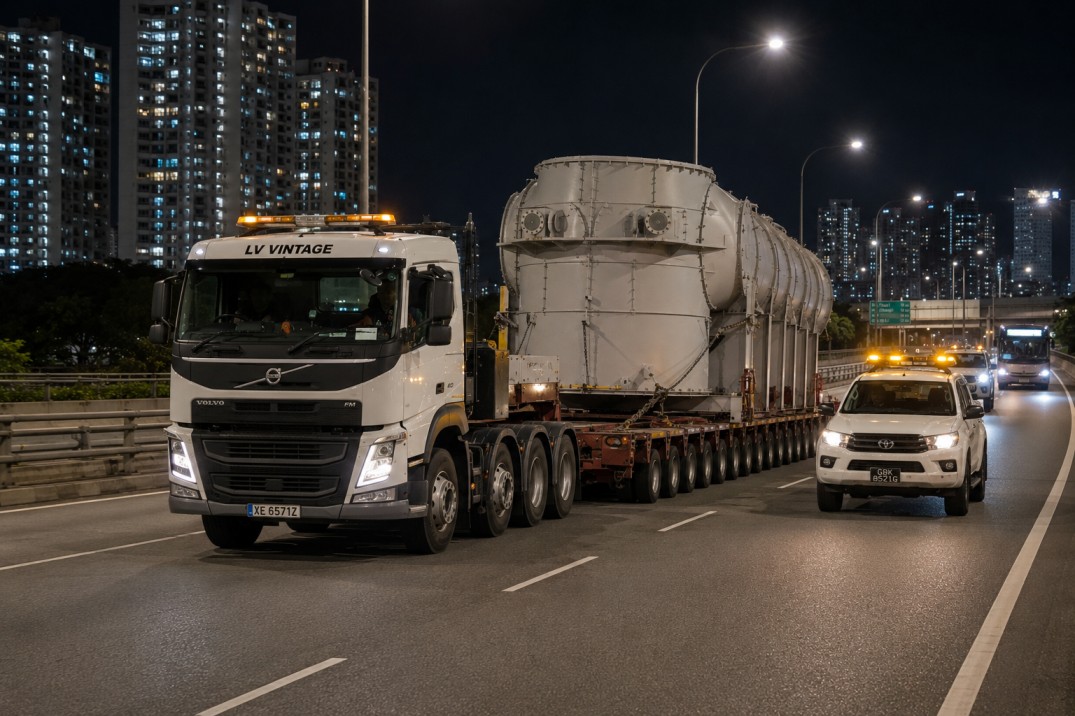
Depending on how far your cargo exceeds the statutory limits, the LTA might require physical escorts to guide your oversized convoy. This ensures public safety and minimizes traffic disruption. The escort framework falls into two categories:
Company-Provided Self-Escort (Vehicle Escort)
Required when:
- The total width of the vehicle and load is between 3.0 meters and 3.4 meters.
- The rear overhang of the cargo exceeds allowable standard limits.
- The operator must deploy a designated escort vehicle equipped with warning lights and retroreflective decals to warn oncoming and trailing traffic.
Auxiliary Police Force (APF) Escort
Required when:
- The total width of the vehicle and load exceeds 3.4 meters.
- The Gross Vehicle Weight (GVW) exceeds 80,000 kg (80 tonnes).
- The vehicle configuration requires counter-flow traffic routing or major junction closures.
- The operator must coordinate directly with licensed auxiliary police officers (such as Certis CISCO, AETOS, or SATS) to physically control traffic during the movement.
Step-by-Step Heavy Haulage Permit Application Process
Applying for an OVM permit requires accurate data submission, engineering assessments, and proper timing. Mistakes can result in delays, rejected applications, or heavy statutory fines.
Step 1: Technical and Route Specifications Gathering
Before logging into the LTA portal, compile the exact metrics of the transport setup:
- Registration logs of the prime mover and trailer.
- Exact physical dimensions (Width, Length, Height, Rear Overhang).
- Axle spacing distances and precise weight distribution profiles per axle.
- Proposed origin, route plan, and final destination.
Step 2: Professional Engineer (PE) Certification (For Super-Heavy Loads)
If the gross weight of your vehicle exceeds 80 tonnes, the LTA requires a certified Professional Engineer (PE) structural evaluation. The PE will calculate whether the heavy load can safely cross specific flyovers, bridges, or underground structures along your intended path without causing catastrophic structural strain.
Step 3: Application Submission via LTA Portal
Submit the application online through the LTA’s official portal (ONE.MOTORING under the OVM application framework).
- Standard Processing Timeline: It is highly recommended to submit applications at least 3 to 7 working days prior to the scheduled move.
- Ad-Hoc vs. Term Permits: For single irregular moves, apply for an Ad-Hoc Permit. If you run routine movements using identical configurations and routes, you can apply for a Term Permit (valid for up to 3 or 6 months, subject to dimensional caps).
Step 4: Coordination with Auxiliary Police and Agencies
Once conditional approval is issued, secure your APF escort bookings if your cargo falls within the mandatory police escort brackets. Additionally, coordinate with agencies like the Housing & Development Board (HDB) or JTC Corporation if your route involves passing through residential estates or industrial complexes with low overhead height restrictions.
Step 5: Execution Under Strict Operating Hours
Heavy haulage movements are almost universally restricted to specific off-peak windows to minimize congestion—typically between 1900 hours and 0600 hours the following morning. The transport team must strictly adhere to the approved route listed on the physical permit certificate.
The Risks of Operating Without a Permit
Failing to secure an OVM permit or violating its explicitly stated terms carries severe consequences under Singapore law:
- Heavy Monetary Fines: Convictions under the Road Traffic Act can lead to steep fines for both the driver and the transport company.
- Vehicle Impoundment: LTA enforcement officers have the authority to intercept and immediately impound non-compliant vehicles on the spot.
- Business De-registration & Liability: Chronic non-compliance can result in a business losing its commercial transport licenses, alongside voided corporate insurance coverages in the event of an accident.
To eliminate compliance risks, many local businesses choose to entirely outsource their complex transportation projects. Utilizing a comprehensive Lorry Rental With Driver Singapore service guarantees that trained, licensed drivers who are well-versed in local regulations handle your shipments safely and legally.
Streamlining Your Heavy Haulage Logistics
Managing heavy haulage permits requires precision, deep regulatory knowledge, and a compliant fleet. If your core business focus is construction, manufacturing, or engineering, managing these logistics internally can draw valuable time and resources away from your main operations.
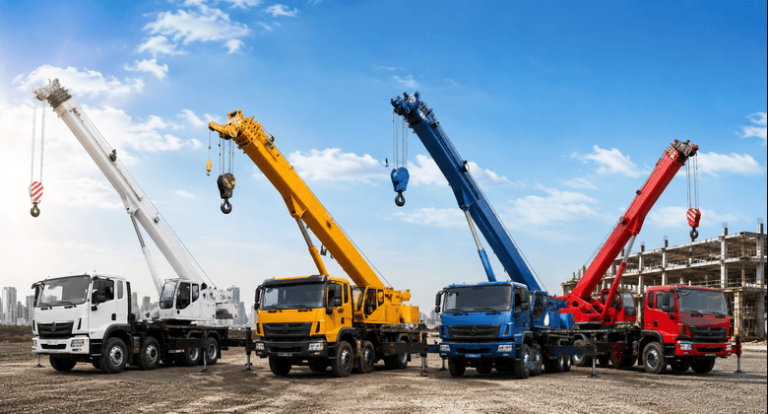
Partnering with an experienced provider like Nam Seng Cargo simplifies the process. Backed by over 35 years of logistics experience since 1988, Nam Seng Cargo provides comprehensive Logistics & Cargo Services, including flatbeds, lorry cranes, and experienced operators. Their team handles technical calculations, route planning, and LTA permit submissions to keep your cargo moving safely and efficiently within full legal boundaries.
FAQs
How long does it take for the LTA to approve a Heavy Haulage Permit?
Standard oversized loads usually take 3–5 working days. Complex cases (80+ tonnes requiring PE calculations) may take up to 2 weeks or more.
Can I transport multiple oversized items on a single permit?
No. An OVM permit is only for an indivisible load. Multiple separate items require separate applications or transport arrangements.
What happens if a road on my approved route is unexpectedly blocked?
You must stop operations safely and contact LTA or escort authorities. You cannot change the route on your own.
Do I need an OVM permit if my vehicle is empty but oversized?
Yes. If the vehicle or trailer exceeds legal dimensions or weight limits, a permit is required even when empty.
What are the standard operating hours for moving oversized loads?
Typically, movements are allowed from 7:00 PM to 6:00 AM, with stricter windows (e.g., midnight–5:00 AM) for heavier loads.
Conclusion
Managing heavy haulage permits demands strict regulatory precision. Partnering with an experienced logistics provider like Nam Seng Cargo—offering comprehensive Logistics & Cargo Services—ensures your heavy transport runs seamlessly and legally. Ready to streamline your heavy cargo operations? Contact Us today to secure your LTA permits hassle-free.