When a perishable shipment lands at Changi, the clock starts immediately. Fresh seafood from Norway, cut flowers from the Netherlands, vaccines from Germany, none of these wait for slow paperwork or an unconfirmed truck. The cold chain is unforgiving. One missed step and the entire consignment is at risk.
Singapore Changi Airport moves more than two million tonnes of air cargo annually. It serves over 150 cities worldwide and handles some of the most time-critical cargo categories in the region, pharmaceuticals, fresh produce, live animals, and high-value express goods. Managing Changi cargo clearance correctly, especially for perishable shipments, requires preparation well before the aircraft lands.
Nam Seng Cargo has supported Singapore’s cargo and logistics sector since 1988. This guide explains the clearance process, the shipment types that need the most attention, and how to avoid the delays that put perishable cargo at risk.
What Is Changi Cargo Clearance?
Changi cargo clearance covers every step needed to release an incoming air shipment and move it into Singapore’s supply chain. That includes customs declarations submitted through Singapore’s TradeNet system, regulatory permit approvals from agencies such as the Singapore Food Agency, the Health Sciences Authority, and the National Environment Agency, and the physical collection and transport of cargo once it is released.
Every commercial shipment, whether import, export, or transshipment, goes through this process. For temperature-sensitive goods, the speed of that process directly affects cargo condition. A shipment that clears quickly moves into cold storage or onward transport while quality is still intact. A shipment held up by missing documentation can be compromised before it ever leaves the airport.
Getting Changi cargo clearance right means preparing everything before the flight departs the origin, not after it lands.
Why Changi Is the Region’s Leading Air Cargo Hub
Changi Airport’s cargo infrastructure is built for specialist handling at scale. Several facilities make it the preferred gateway for time-sensitive imports and exports across Southeast Asia.
Coolport at the Changi Airfreight Centre, operated by SATS, handles fresh, chilled, and frozen cargo with dedicated temperature zones. dnata Singapore operates its own pharma and perishable handling centre at Changi, capable of processing 75,000 tonnes of temperature-sensitive goods annually and certified under IATA’s CEIV Fresh standard.
The Changi Airfreight Centre houses freight forwarders, customs agents, and logistics operators in one dedicated cargo district adjacent to the airport. The Airport Logistics Park of Singapore supports bonded storage and value-added logistics within the Free Trade Zone.
Perishable shipments account for approximately 13% of Changi’s total air cargo volume, with Australia, Norway, and India among the key trading markets. These specialized facilities and handling standards help support efficient Changi Cargo Clearance for time-sensitive perishable shipments.
Which Shipments Need the Fastest Clearance?
Fresh Food and Seafood
Chilled produce, live seafood, cut flowers, and fresh meat all deteriorate quickly at ambient temperatures. Singapore Food Agency import permits apply to most food categories and must be secured through TradeNet before the aircraft arrives. Once cleared, these shipments must transfer directly into refrigerated transport without unnecessary dwell time at the terminal.
Pharmaceutical Products
Vaccines, biologics, clinical trial materials, and regulated medicines often require Health Sciences Authority approval alongside standard customs clearance. Many must stay within a defined temperature range from origin to final delivery. A gap anywhere in that chain, including the transport leg from Changi to the consignee, can invalidate the shipment entirely.
Live Animals and Biological Samples
Animal imports require permits and veterinary documentation from the relevant Singapore authorities. Biological samples for laboratory use may need additional clearance depending on their classification. Both categories require immediate handling on arrival and zero tolerance for delays.
High-Value Electronics and Express Goods
Semiconductors, luxury products, and urgent e-commerce inventory do not face temperature risks but carry significant financial exposure the longer they sit at the terminal. Accurate HS codes, correct commercial invoice values, and confirmed transport on release are all essential.
The Changi Cargo Clearance Process
Step 1: Pre-arrival preparation
The freight forwarder or shipper submits the air waybill, commercial invoice, packing list, and customs declaration through TradeNet before the aircraft lands. Regulated goods need permits from SFA, HSA, or NEA obtained in advance. Preparing these documents correctly is the single most effective way to prevent clearance delays.
Step 2: Arrival and terminal handling
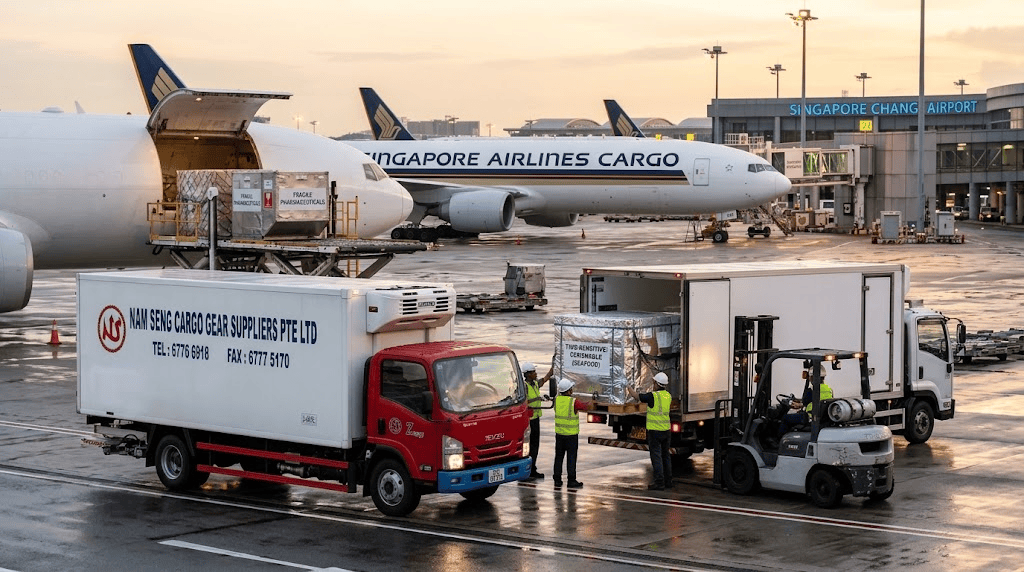
After landing, cargo is transferred to the designated terminal. Perishable shipments move directly to Coolport or the appropriate temperature-controlled facility. Ground handling at Changi is managed primarily by SATS and dnata Singapore depending on the airline and cargo type.
Step 3: Customs review
Singapore Customs processes declarations and may select shipments for physical examination. Accurate cargo descriptions, correct tariff classifications, and matching values across all documents reduce the chance of being flagged for inspection.
Step 4: Release
Once permits are approved and applicable duties or GST are settled, the cargo is released. With correct documentation in place, most commercial shipments clear within a few hours of arrival.
Step 5: Collection and delivery
Cleared cargo is collected from the terminal and transported to the consignee. Perishable and pharmaceutical shipments require vehicles suited to their temperature requirements. Nam Seng Cargo’s lorry and truck rental service covers refrigerated trucks for cold chain cargo and standard lorries for ambient goods, with island-wide delivery from Changi to any Singapore address.
What Causes Delays and How to Prevent Them
Most clearance problems at Changi are caused by the same avoidable mistakes. Missing permits are the most common issue. SFA, HSA, or NEA approvals not secured before arrival put shipments on hold immediately. Apply for every applicable permit before the aircraft departs.
- Incorrect HS codes trigger examination. Verify tariff classification before submission, not after the shipment is flagged.
- Incomplete documents cause TradeNet rejections. Check that consignee details, cargo descriptions, declared values, and shipper information are consistent across the air waybill, invoice, and packing list.
- Undeclared controlled goods attract penalties and seizure. If a product has any regulatory restriction in Singapore, declare it correctly and secure the required approval.
No transport confirmed on release is the most damaging mistake for perishable cargo. A shipment sitting at the terminal after clearance loses cold chain integrity fast. Confirm the vehicle and collection schedule before the aircraft lands, not after clearance is approved.
Nam Seng Cargo: Changi Airport Cargo Services
Nam Seng Cargo has supported Singapore’s cargo and logistics sector since 1988 and holds ISO 9001:2015 certification and bizSAFE Star accreditation. Airport cargo services cover ground handling coordination, cargo collection from Changi terminals, and island-wide transport to any delivery address.
Businesses that need warehouse storage between clearance and final delivery can use Nam Seng Cargo’s warehousing and storage service, a secure facility accessible from Changi and Singapore’s main logistics corridors.
Jobs requiring trained cargo handlers for unloading and positioning at the delivery point are covered by the manpower and labour supply service, with WSH-compliant workers deployable on short notice island-wide.
For broader port and cargo ground handling beyond airport operations, the stevedoring and ground handling service covers the full scope of Singapore cargo handling at sea and on land.
Frequently Asked Questions
What is Changi cargo clearance and how long does it take?
It is the customs and regulatory process for releasing air cargo at Singapore Changi Airport. With complete documentation and pre-approved permits, most commercial shipments clear within two to six hours of arrival.
What permits are needed for fresh food imports through Changi?
Most food imports require a Singapore Food Agency permit submitted via TradeNet before arrival. The specific requirements depend on product type and origin.
Does Changi have cold storage for perishable cargo?
Yes. Coolport by SATS and Coolchain by dnata Singapore both provide temperature-controlled storage at the Changi Airfreight Centre for fresh, chilled, and frozen shipments.
How do I arrange transport from Changi after clearance?
Contact Nam Seng Cargo with the air waybill number, cargo type, collection terminal, and delivery address. The team confirms the right vehicle and coordinates collection for the moment clearance is approved.
Final Thoughts
Changi cargo clearance is where time-sensitive shipments either stay on track or fall apart. The airport has world-class facilities. The cold storage is there. The connectivity is unmatched in the region. But none of that protects a shipment if the documentation is incomplete, the permits are missing, or the transport is not confirmed before the cargo is released.
Preparation is essential. Nam Seng Cargo has supported Singapore’s cargo and logistics industry since 1988. Contact Nam Seng Cargo with your shipment details to discuss your requirements and receive a written quotation within one working day.