Heavy lifting goes wrong when the wrong people are in charge of it. A load that shifts mid-air. A sling that was not rated for the weight. A lift plan that was never prepared. These are not hypothetical risks, they are the causes of real incidents on Singapore worksites every year.
Hiring a certified rigger Singapore is not just a regulatory requirement. It is the practical difference between a lift that completes safely and one that does not. Whether the job involves lifting industrial machinery onto a vessel, positioning a transformer at a construction site, or moving a heavy fabricated structure at a port terminal, the rigger controls every critical step of the operation.
Nam Seng Cargo has been providing certified rigging and heavy lift support across Singapore since 1988. This guide explains what a certified rigger does, what Singapore regulations require, and what to look for when hiring rigging services for your project.
What Is a Certified Rigger Singapore?
A certified rigger in Singapore is a professional who has completed formal training and assessment in rigging operations and holds a valid certification recognised under Singapore’s Workplace Safety and Health framework. Riggers are responsible for attaching, securing, and guiding loads during crane and heavy lift operations.
When hiring a certified rigger in Singapore, look for professionals with knowledge of load calculations, centre of gravity, sling angles, lifting equipment ratings, and safe work procedures. A certified rigger selects the correct rigging configuration for each lift, inspects all equipment before use, and works closely with the crane operator throughout the operation.
In Singapore, the Ministry of Manpower requires lifting operations involving cranes and other lifting machines to be carried out by trained and competent personnel. A certified rigger satisfies that requirement and ensures the lift is planned, executed, and documented to the required standard.
What Does a Certified Rigger Actually Do?
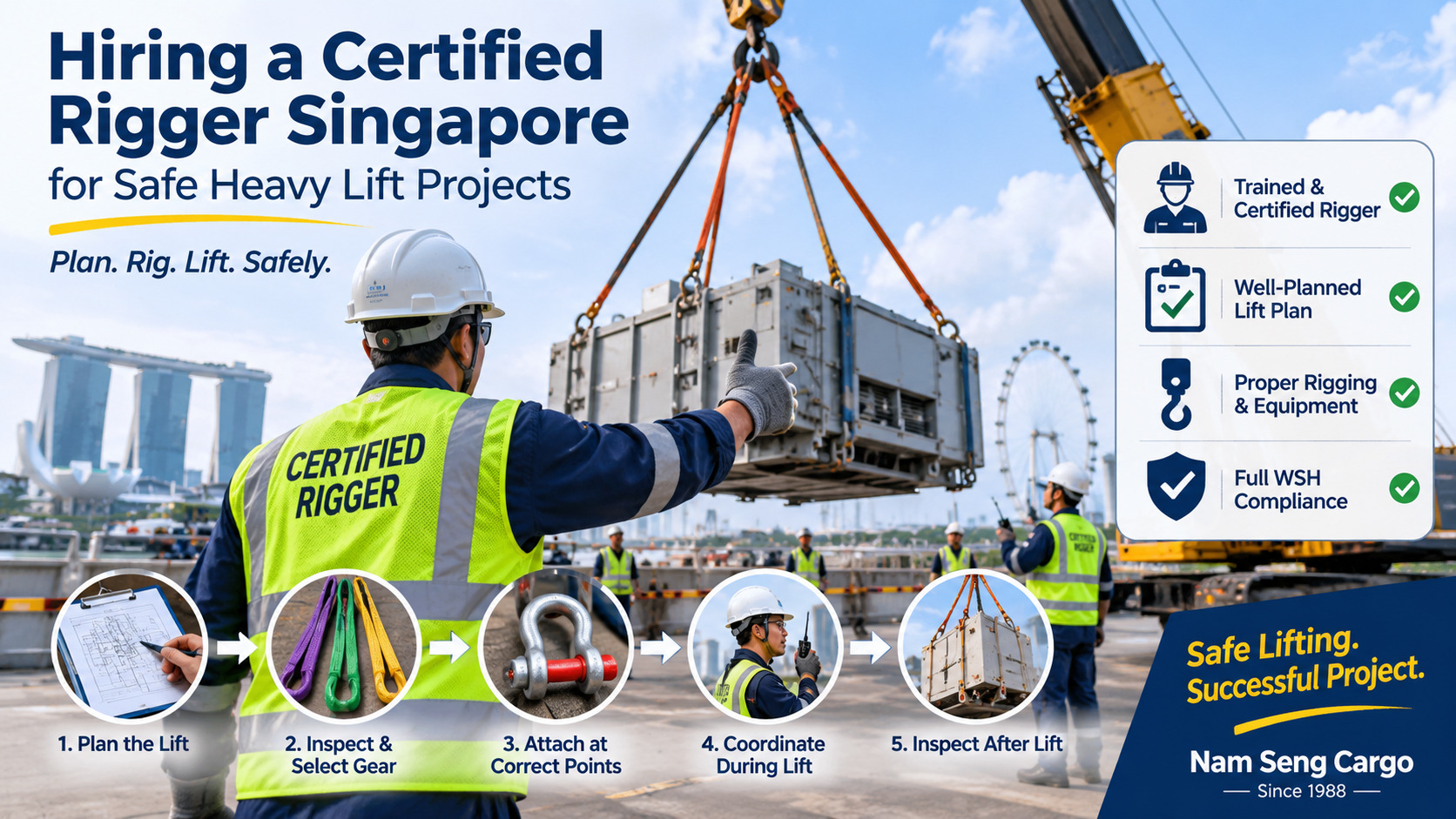
The rigger’s work starts well before the crane lifts the load. Every stage of a heavy lift involves the rigger’s direct input and responsibility.
Pre-Lift Planning
Before any lift begins, the rigger assesses the load. Weight, dimensions, centre of gravity, and lifting points are all confirmed. A lift plan is prepared covering the equipment to be used, the rigging configuration, the movement path, and any site-specific hazards. For complex or critical lifts, an engineered lift plan prepared with input from a qualified lifting supervisor is required.
Equipment Inspection and Selection
When hiring a certified rigger in Singapore, ensure all rigging equipment is inspected before use. Wire rope slings, chain slings, synthetic web slings, shackles, hooks, spreader bars, and lifting beams must be rated for the load and confirmed free of damage. Any equipment showing visible wear, deformation, or missing certification tags must be removed from service before lifting begins.
Load Attachment and Slinging
The rigger secures the load at the correct lifting points and uses suitable slings to ensure safe weight distribution. Sling angles affect the load on each leg, a rigger understands these calculations and applies them correctly every time. Incorrect slinging is one of the most common causes of dropped loads and equipment damage.
Lift Coordination and Signalling
During the lift, the rigger communicates between the load and the crane operator to ensure safe handling. Standard hand signals and radio communication are used to guide the crane through each movement. The rigger controls the speed and direction of travel, watches for obstructions, and calls for stops immediately if anything is not right.
Post-Lift Inspection and Derigging
After the load is set down and secured, the rigger removes the rigging equipment, inspects it for any damage sustained during the lift, and stores it correctly. Documentation of the lift, equipment used, any observations, and sign-off, is completed before the team leaves the site.
Singapore Regulations for Rigging and Heavy Lift Operations
Singapore’s Workplace Safety and Health Act and its subsidiary regulations establish clear requirements for lifting operations. These apply to construction sites, industrial facilities, port terminals, and workplaces where cranes or lifting machines are used. When hiring a certified rigger in Singapore, businesses should ensure the rigging team meets the following safety and competency requirements:
Key requirements include:
- Lifting operations must be planned and supervised by a Lifting Supervisor who meets MOM competency requirements
- Riggers and crane operators must be trained and competent for the type of lift being performed
- All lifting equipment must be tested and certified by an Authorised Examiner before use and at prescribed intervals
- A lifting plan must be prepared for every lifting operation, covering load details, equipment, rigging configuration, and safety measures
- Lifting gear must carry valid colour-coded inspection tags confirming they have been examined within the required period
Businesses that engage a rigging team without verifying these requirements carry full liability for any incident that occurs. Nam Seng Cargo’s rigging team operates under full WSH compliance, MOM-certified riggers, inspected and certified lifting gear, and documented lift plans prepared before every job.
When Do You Need a Certified Rigger in Singapore?
Hiring a certified rigger in Singapore is essential for heavy lifting operations involving cranes or mechanical equipment. Across Singapore’s industrial and logistics sectors, certified riggers provide essential support in the following applications:
- Industrial machinery installation, positioning heavy plant, generators, compressors, and processing equipment at factories and industrial facilities in Tuas, Jurong, and Woodlands
- Port and marine operations, loading and discharging heavy cargo, project equipment, and offshore components at Jurong Port, Pasir Panjang, and Keppel terminals
- Construction site lifting, structural steel, precast elements, and heavy building components require rigging support throughout the construction programme
- Offshore and marine fabrication, module lifts, skid installations, and heavy equipment transfers at Singapore’s fabrication yards
- Power and utilities, transformer installations, generator placements, and switchgear lifts at power stations, substations, and data centres
- Warehouse and logistics moves, heavy racking systems, industrial equipment, and large machinery moved during warehouse relocations or fit-out projects
For jobs that also require a lorry crane on site, Nam Seng Cargo’s lorry and truck rental service provides lorry cranes with certified operators alongside the rigging team, one booking covers the vehicle, the crane, and the crew.
What to Check When Hiring a Certified Rigger in Singapore
Not all rigging services are equal. Verifying these points before confirming a rigging team protects your project and your liability.
MOM Certification
Confirm that the riggers provided hold valid MOM-recognised certifications for the type of lift involved. Ask for copies of certification documents before the job starts.
Lifting Gear Certification
All slings, shackles, hooks, and lifting accessories must carry current colour-coded inspection tags. Confirm that the provider maintains a register of lifting gear with valid examination records.
Lift Plan Preparation
Hiring a certified rigger Singapore always prepares a lift plan before the job. If a provider cannot provide a written lift plan for your job, that is a serious warning sign. Refuse to proceed without one.
WSH Track Record
Check that the company holds bizSAFE accreditation and has a verifiable safety record. Nam Seng Cargo holds bizSAFE Star status and ISO 9001:2015 certification, both are externally verified indicators of safety management standards.
Single Supplier Capability
For jobs that require both rigging and cargo transport, using the same provider for both removes coordination risk. Nam Seng Cargo’s manpower and labour supply service provides certified riggers, crane signalmen, and lifting supervisors alongside the transport and equipment fleet, covering the full scope of a heavy lift job from one supplier.
For projects that also require forklift support alongside crane and rigging operations, the forklift and lifting equipment rental fleet at Nam Seng Cargo covers electric, diesel, and LPG forklifts available for hire alongside the rigging team.
Nam Seng Cargo: Certified Rigger Singapore Services
Nam Seng Cargo has been delivering heavy lift and rigging support across Singapore’s port, industrial, and construction sectors since 1988. The company holds ISO 9001:2015 certification and bizSAFE Star accreditation and is a BCA-registered contractor for government and institutional site work.
Nam Seng Cargo provides hiring a certified riggers in Singapore, with a team of MOM-certified riggers, lifting supervisors, and crane signalmen experienced across major industrial zones and port terminals. All lifting equipment is inspected and colour-coded according to current safety standards, with lift plans prepared before every job to ensure safe and coordinated lifting operations.
Frequently Asked Questions
What is a certified rigger Singapore and why is one required?
Hiring a certified rigger Singapore is a trained professional qualified under MOM’s Workplace Safety and Health framework to plan and execute rigging operations for heavy lifts. Singapore regulations require competent and trained personnel for all crane and lifting machine operations. Using an uncertified rigger on a Singapore worksite creates serious legal and safety liability.
What certifications should a rigger hold in Singapore?
Riggers in Singapore should hold MOM-recognised training certifications for rigging and slinging operations. The team should also include a certified Lifting Supervisor for planned lifting operations. All lifting gear used must be examined and certified by an Authorised Examiner with valid inspection records.
What is a lift plan and is it required in Singapore?
A lift plan is a written document covering the load weight and dimensions, rigging configuration, equipment to be used, movement path, and site safety measures. It is required under Singapore WSH regulations for all lifting operations and must be prepared before the lift begins.
Can a certified rigger also operate a crane in Singapore?
A rigger and a crane operator are separate roles with separate certification requirements. A rigger safely secures the load and guides its movement. A crane operator controls the crane. Both must be present and certified for a compliant heavy lift operation in Singapore.
How do I get a quote for certified rigger Singapore services from Nam Seng Cargo?
Contact Nam Seng Cargo with the load weight and dimensions, site address, lift type, equipment access details, and required dates. A written quote is returned within one working day.
Final Thoughts
A heavy lift is only as safe as the team managing it. The load calculation, the sling selection, the lift plan, the communication with the crane operator, every one of these is the rigger’s responsibility. Getting any of them wrong has consequences that cannot be undone.
Hiring a certified rigger Singapore means putting a trained, qualified professional in charge of that responsibility. This means the lifting plan is prepared in advance. The gear is certified. The signals are clear. And the load moves safely from start to finish.
Nam Seng Cargo has been providing certified rigging and heavy lift support across Singapore since 1988. Reach out with your project details and get a written quote within one working day.